Legislative & Regulatory
2026 Legislative Session
Bills
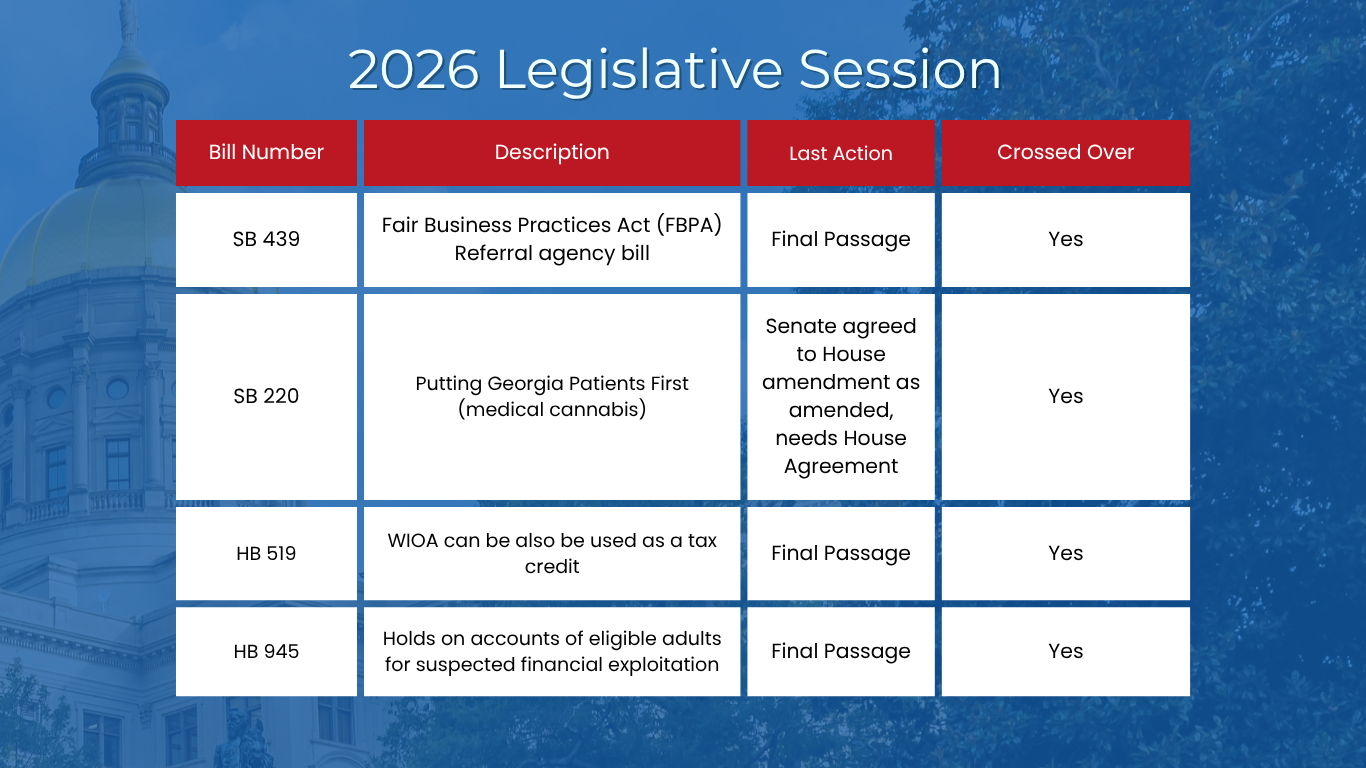
SB 220: Also known as "Putting Georgia's Patients First Act", this bill makes some reforms to Georgia's Low-THC Oil law and expands access for other forms of medical cannabis. It allows vapor delivery of medical cannabis and expands the list of conditions that qualify a patient for the Medical Cannabis registry to include any Alzheimer's disease or Parkinson's diagnosis and severe arthritis.
HB 906: Would require ALCs, PCHs, and SNFs to also post the state Long-Term Care Ombudsman's contact information on the community (or company)'s websites and add GLP-1s to the CMA task list.
SB 439: Requires referral agencies making referrals to ALCs and PCHs to disclose to the resident or their representative how their business works, that they collect a referral fee for successful placements, and that families may have options that meet their needs and preferences other than what the referral agency presents to them. Ties payment of the referral fee to proof of making the disclosure and puts a maximum 24-month time limit for a referral to move-in, and the agency collects their fee.
HB 945: Allows banks to place holds on accounts of disabled or elderly adults when there is suspicion of financial abuse or exploitation. Creates a process for banks to work with a "trusted contact" to resolve questions about suspicious charges on the elderly or disabled adult's account.
HB 519: Creates a state tax credit up to $500 per employee per year if also claiming federal work opportunity tax credits for that employee.
2025 Legislation: Bills that Passed
SB 68 - Comprehensive Tort Reform: SB 68 delivers long-needed updates to Georgia’s civil justice system by addressing legal loopholes, curbing lawsuit abuse, and lowering costs for businesses, healthcare providers, and consumers. Championed by Governor Kemp, this landmark legislation modernizes key legal procedures while ensuring fair treatment for all parties involved in civil litigation.
Resources:
SB 69 - Third Party Litigation Financing: Senate Bill 69 requires third-party litigation financiers to register with the state, prohibits foreign adversaries from interfering in the state court system by way of TPLF agreements, and provides protections for consumer-plaintiffs entering into TPLF agreements. Additionally, SB 69 allows parties to a lawsuit to seek disclosure of TPLF agreements.
Resources:
HB 645 - COVID Testing Repeal: Repeals a statutory requirement to test new residents and new hires of long term care settings, including ALCs and PCHs, for COVID-19. This bill does not prohibit any testing that may be necessary or prudent, but simply repeals a requirement that has been left on the books since 2020 and had been largely unenforced by DCH.
HB 579 - Professional Licensing Reforms: Authorizes Professional Licensing Board staff to administratively approve applications for licensure, renewal, or reinstatement when the applicant clearly meets the requirements without waiting for Licensing Board approval, including for Assisted Living Community Administrator license applications. If it is not clear to the licensing division staff that the applicant meets the criteria for licensure, the application is forwarded to the Board for approval or denial.
SB 125 - Continuing Education Credit Tracking: Creates a CEU tracking system within the Professional Licensing Board division under the Secretary of State's Office. Beginning January 1 2026, all required CEUs must be verified through the tracking system in order for a license to be renewed, but CEU's do not have to be offered through the tracking system in order to be approved.
HB 238 - Dementia Training for POST Officers: Directs the Georgia Public Safety Training Center to create and maintain a training course available to all law enforcement officers, emergency medical personnel, and behavioral health co-responders pertaining to adults with Alzheimer's or related dementias. Training will include investigating elder abuse and financial exploitation, recognizing behavioral indicators of Alzheimer's and other dementias and ways to effectively communicate with persons with Alzheimer's, and protocols for responding to reports of missing adults.
SB 220: Also known as "Putting Georgia's Patients First Act", this bill makes some reforms to Georgia's Low-THC Oil law and expands access for other forms of medical cannabis. It allows vapor delivery of medical cannabis and expands the list of conditions that qualify a patient for the Medical Cannabis registry to include any Alzheimer's disease or Parkinson's diagnosis and severe arthritis.
HB 906: Would require ALCs, PCHs, and SNFs to also post the state Long-Term Care Ombudsman's contact information on the community (or company)'s websites and add GLP-1s to the CMA task list.
SB 439: Requires referral agencies making referrals to ALCs and PCHs to disclose to the resident or their representative how their business works, that they collect a referral fee for successful placements, and that families may have options that meet their needs and preferences other than what the referral agency presents to them. Ties payment of the referral fee to proof of making the disclosure and puts a maximum 24-month time limit for a referral to move-in, and the agency collects their fee.
HB 945: Allows banks to place holds on accounts of disabled or elderly adults when there is suspicion of financial abuse or exploitation. Creates a process for banks to work with a "trusted contact" to resolve questions about suspicious charges on the elderly or disabled adult's account.
HB 519: Creates a state tax credit up to $500 per employee per year if also claiming federal work opportunity tax credits for that employee.
2025 Legislation: Bills that Passed
SB 68 - Comprehensive Tort Reform: SB 68 delivers long-needed updates to Georgia’s civil justice system by addressing legal loopholes, curbing lawsuit abuse, and lowering costs for businesses, healthcare providers, and consumers. Championed by Governor Kemp, this landmark legislation modernizes key legal procedures while ensuring fair treatment for all parties involved in civil litigation.
Resources:
SB 69 - Third Party Litigation Financing: Senate Bill 69 requires third-party litigation financiers to register with the state, prohibits foreign adversaries from interfering in the state court system by way of TPLF agreements, and provides protections for consumer-plaintiffs entering into TPLF agreements. Additionally, SB 69 allows parties to a lawsuit to seek disclosure of TPLF agreements.
Resources:
HB 645 - COVID Testing Repeal: Repeals a statutory requirement to test new residents and new hires of long term care settings, including ALCs and PCHs, for COVID-19. This bill does not prohibit any testing that may be necessary or prudent, but simply repeals a requirement that has been left on the books since 2020 and had been largely unenforced by DCH.
HB 579 - Professional Licensing Reforms: Authorizes Professional Licensing Board staff to administratively approve applications for licensure, renewal, or reinstatement when the applicant clearly meets the requirements without waiting for Licensing Board approval, including for Assisted Living Community Administrator license applications. If it is not clear to the licensing division staff that the applicant meets the criteria for licensure, the application is forwarded to the Board for approval or denial.
SB 125 - Continuing Education Credit Tracking: Creates a CEU tracking system within the Professional Licensing Board division under the Secretary of State's Office. Beginning January 1 2026, all required CEUs must be verified through the tracking system in order for a license to be renewed, but CEU's do not have to be offered through the tracking system in order to be approved.
HB 238 - Dementia Training for POST Officers: Directs the Georgia Public Safety Training Center to create and maintain a training course available to all law enforcement officers, emergency medical personnel, and behavioral health co-responders pertaining to adults with Alzheimer's or related dementias. Training will include investigating elder abuse and financial exploitation, recognizing behavioral indicators of Alzheimer's and other dementias and ways to effectively communicate with persons with Alzheimer's, and protocols for responding to reports of missing adults.
Legislative & Regulatory Information
Georgia Senior Living Rules & Regulations:
Additional Resources
Additional Legislative & Regulatory information is on the Members Only page.
To log in to the Members Only page, click on the link for Members Only on the right. If you do not have a username and password, please call the GSLA office at 678-407-2060.
Become a member of GSLA to have access to GSLA's Frequently Asked Questions, found in the Members Only section of our website!
Additional Legislative & Regulatory information is on the Members Only page.
To log in to the Members Only page, click on the link for Members Only on the right. If you do not have a username and password, please call the GSLA office at 678-407-2060.
Become a member of GSLA to have access to GSLA's Frequently Asked Questions, found in the Members Only section of our website!